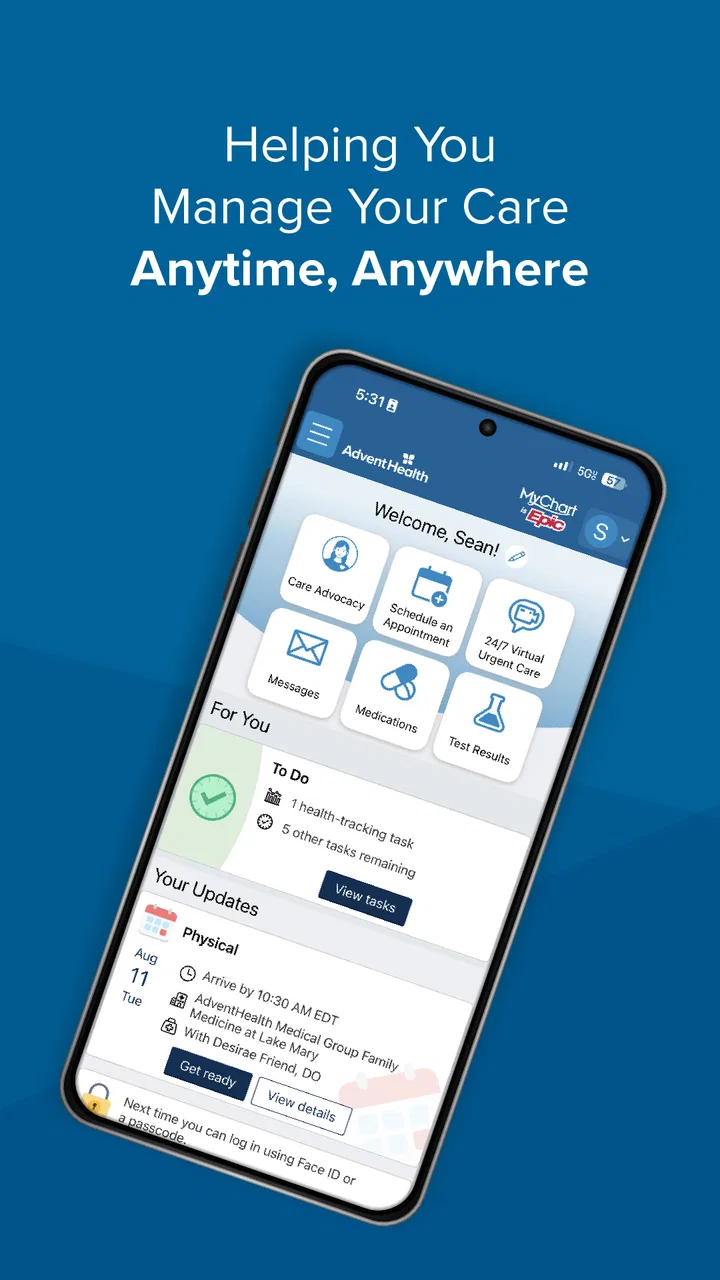
AdventHealth
- 3.9
- Rating
- 500.00K
- Installs
- Free
- Price

 Analysis by App-foxy
AdventHealth is a free medical app from AdventHealth that aims to make everyday health care easier to reach from a phone. I approached it less like a digital brochure and more like a practical tool: can I find the right place, understand what I am looking at, and use it when I am tired, worried, or dealing with limited time? That is the standard a health app needs to meet.
My overall impression is that it is most useful for people who already interact with AdventHealth and want a more convenient starting point for care-related tasks. It is available for Everyone, has passed the 100K+ install mark, and currently appears as version 5.6.1. Those details do not tell the whole story, but they do place the app in the category of an established patient-facing medical tool rather than a specialist clinical application.
How the app feels to read and navigate
The first thing I look for in a medical app is whether it reduces mental effort. Health care is rarely used in a relaxed state. You may be trying to arrange help while looking after a child, checking something late at night, or dealing with pain. AdventHealth works best when I treat it as a focused doorway into the health system, not as an app I casually browse for entertainment.
You May Also Like

 Blood Strike: 2.5 Anniversary
Blood Strike’s Loadouts Turn Every Drop Into a Tactical Gamble
A close look at Blood Strike’s custom loadouts: how fast access to signature weapons reshapes its battle royale rhythm, rewards preparation, and narrows the gap between fights.

 Pandora - Music & Podcasts
Pandora’s Music Is Easy to Start, but Harder to Recover
Pandora’s strength is its low-effort path from a seed to a station. Its weak spot is how much confidence it asks you to place in connection, setup, and quiet recovery.

 8 Ball Pool
 Is Built on Rivalries, Rematches, and Routine
A close look at the rivalries, rematches, shared routines, and unanswered safety questions that turn a quick pool match into a persistent mobile community.

 Samsung Music
’s Quiet Strength Is Playing What You Already Own
Its reach comes less from spectacle than from dependable access to a personal library. That simplicity is both the app’s strongest retention engine and its ceiling.

 AccuWeather: Weather Radar
AccuWeather Review: A Quick, Clear Forecast for Everyday Decisions
For everyday plans, the best forecast is the one you can understand quickly. AccuWeather makes rain timing, radar, and local conditions easy to act on, with a few trade-offs.

 Hill Climb Racing
Why Hill Climb Racing Still Turns Crashes Into One More Run
A tiny car, a bumpy hill and one more upgrade: Hill Climb Racing keeps resurfacing because its simple chaos makes every near-miss feel personal.
More From Our News Desk



Its strongest potential is the way a dedicated health-care app can gather useful actions in one place. Instead of moving between a general browser, a phone contact list, and separate pages for different services, I can begin with the app and follow the route it provides. That matters for people who prefer a clear, familiar starting point, especially when remembering a web address or finding the correct page is difficult.
I also pay attention to wording. Medical terms can be intimidating when they appear without context, and a good patient app should make the next action obvious. In my experience, the most comfortable way to use AdventHealth is to slow down and read each screen rather than tapping quickly through menus. That is not a criticism unique to this app; it is a sensible habit whenever a choice could affect an appointment, a care location, or communication with a provider.
For users with reduced vision, readability depends on more than whether text is technically present. Clear spacing, predictable grouping, and a sensible contrast between controls and background can make a larger difference than decorative design. I would use the phone’s own display settings, including text enlargement or contrast options where available, and check whether the layout remains understandable before relying on the app during an urgent situation.
The app’s average rating is 3.6 from around 5.9K ratings, with roughly 2.3K written reviews. I read that as a sign to keep expectations realistic. A medical app can be valuable while still producing frustration for some people, because problems may come from sign-in steps, device differences, account details, or the complexity of the health system behind the interface. I would not judge it solely by its rating, but I also would not assume every task will feel effortless.
Useful habits for clearer reading
I recommend setting up the app when you are calm rather than waiting until you urgently need care. That gives you time to inspect the navigation, adjust your phone’s text settings, and learn where important actions appear. If you use a screen reader, magnification, or another assistive setting, test the complete path you expect to use, not only the opening screen.
A second practical habit is to keep the app and your phone’s operating system reasonably current. AdventHealth lists Android 9 as the minimum operating-system requirement, so older devices may not be suitable. Even on a supported phone, an outdated system or a crowded device can make touch controls and screen changes feel less reliable.
I would also avoid making decisions from a quick glance at a notification. Open the relevant screen, read the full wording, and confirm that you are acting on the correct person or care need. This is particularly important in households where one phone is used to manage information for more than one family member.
Motor, sensory, and cognitive considerations
People use medical apps with very different physical and sensory abilities. Someone may have limited finger movement, tremors, temporary weakness, low vision, hearing loss, dyslexia, or difficulty concentrating because of illness. AdventHealth can be part of a helpful workflow for those users, but I would not treat the mere presence of a mobile interface as proof that every access need has been covered.
For motor access, the key question is how much precise tapping the app demands. A person with shaky hands benefits from a short route with large, clearly separated controls and minimal dependence on tiny icons. When a screen asks for several fields or transitions, I prefer to pause between steps and confirm what changed. If the app makes an important action depend on a small target or a fast gesture, the phone’s accessibility tools may help, but they cannot fix every design problem.
Voice input can be useful for entering longer information, particularly when typing is painful or slow. Still, health details are sensitive, so I would use dictation only in a private place and review every word before submitting it. Names, medications, and medical terms are exactly the kinds of words that automated speech recognition can misunderstand.
For sensory access, I would combine the app with the phone’s built-in screen reader, larger text, display zoom, color adjustments, and sound or vibration settings as appropriate. These tools can improve the experience, but the result may vary depending on how each screen labels controls and presents changing content. If a screen reader does not announce an action clearly, the safest response is to use another route for that task rather than guessing.
People with hearing loss should not assume that a visual interface removes every communication barrier. A phone-based health workflow may still lead to a call or another interaction where spoken communication becomes important. Before an appointment or care request, I would make a note of any communication preference and be ready to use an alternative channel if the app does not support the conversation in the way I need.
Cognitive load is another overlooked issue. When someone is anxious, even ordinary menus can feel confusing. I find it helpful to write down the goal before opening the app: find care, review a detail, prepare for a visit, or contact the appropriate service. That simple step prevents wandering through unrelated screens and lowers the chance of selecting the wrong option.
Where it helps in a real day
Imagine I wake up with a health concern and need to decide what to do before work. I do not want to search the web for several similar-looking pages or rely on memory for the right AdventHealth contact. I can open the app, identify the relevant pathway, and use the information there as my starting point. If the route is clear, that saves attention at exactly the moment when attention is limited.
Another realistic situation is helping a parent or partner manage care. I can use the app as part of a shared preparation routine: gather the questions we want answered, check the details already available to us, and keep the phone ready during the conversation. The important benefit is not simply convenience. It is reducing the number of separate places where information has to be remembered.
For a person with limited mobility, avoiding an unnecessary trip can be meaningful. A first digital step may help clarify whether the next action should involve a visit, a phone conversation, or another form of assistance. I would still treat the app as a navigation aid rather than a substitute for professional judgment, especially if symptoms are severe or rapidly changing.
Access in different situations and environments
Accessibility is also situational. A person who uses the app comfortably at home may struggle in a bright waiting room, a noisy bus, or a room where speaking private information aloud is inappropriate. AdventHealth is most convenient when I have a charged phone, enough time to read carefully, and a stable way to complete the task. Those conditions are easy to overlook until they disappear.
For low-vision use outdoors, screen glare can make even well-spaced content hard to read. I would increase display brightness carefully, use a shaded position, and avoid rushing. For users sensitive to light or motion, a calmer phone configuration may be preferable, though the comfort of the experience will depend on both the device and the app’s screen behavior.
In a noisy environment, visual instructions become more important than sound. I would keep written notes of any key details rather than depending on an audio alert. Conversely, in a quiet public place, privacy becomes the priority. Health information should not be dictated or displayed where other people can easily hear or see it.
Travel and weak connectivity can also change the experience. I would not wait until arriving at a hospital or clinic to discover that I need to complete a step. Preparing earlier, saving essential contact information through an appropriate private method, and knowing how to reach help outside the app are sensible precautions. A health app should support a plan, not be the only part of one.
The app is likely to feel most natural for people already connected to AdventHealth’s care environment. If I am looking for general wellness education, symptom information across many health systems, medication reminders, or a broad personal health dashboard, a different medical app may be a better fit. AdventHealth’s value is tied to its role as a patient-facing doorway for its own health-care context, not to being a universal replacement for every health tool.
Remaining barriers and honest limitations
The biggest limitation is that convenience cannot remove the complexity of health care. Even a well-organized app may lead to choices that require careful interpretation. A user with limited digital confidence may still need help during setup or when deciding which pathway matches the situation. I would rather ask a trusted person to sit beside me than hand over private credentials or let someone else make a medical decision on my behalf.
Another barrier is the difference between technical access and practical access. Supporting Android 9 makes the app available to a range of devices, but an older phone may have a smaller screen, slower performance, or weaker support for modern accessibility settings. Someone who relies on an aging device should test the app before depending on it for time-sensitive tasks.
There is also the question of alternatives. A phone call can be better for a person who finds forms difficult, needs immediate clarification, or cannot comfortably navigate a screen. A desktop browser may suit someone who needs larger text and a physical keyboard. In-person assistance may be the right choice when symptoms, language, memory, or communication needs make self-service unsafe. I see the app as one route among several, not a test of independence.
Because the app is free, the financial barrier to trying it is low. That does not mean the surrounding care is free, nor does it mean every user has equal access to a compatible phone, dependable connectivity, or private device use. Those practical realities matter more than the download cost for many people.
I also think users should separate the app’s interface from the quality of the care experience itself. A smooth screen cannot guarantee a quick response, and a frustrating screen does not necessarily reflect the quality of a clinician. If an action is important, I would confirm that it completed successfully and keep any relevant confirmation or contact detail in a secure place.
Who should use it and who should choose another route
I would recommend AdventHealth to an existing AdventHealth patient who wants a central mobile starting point and is comfortable using a smartphone. It can be especially useful for someone who values self-service, wants to prepare before contacting care, or helps coordinate health tasks for a family member. The app’s free price makes it easy to try without adding a purchase decision to an already stressful task.
I would be more cautious about recommending it as the only option for someone with severe vision, motor, hearing, or cognitive barriers. That does not mean the person cannot use it. It means the app should be tested with the person’s actual assistive setup, and a phone or in-person alternative should remain available. The best workflow is the one that can be completed accurately and without unnecessary strain.
I would also skip it as a primary tool if I do not use AdventHealth or if my main goal is broad health tracking. A general health platform, a specialist medication tool, or direct communication with a clinician may offer a closer match. Choosing a more specialized alternative is not a failure of this app; it is simply a matter of using the right tool for the job.
Before relying on it, I would answer a few practical questions for myself. Can I read the important screens with my current display settings? Can I complete the key action without precise tapping? Do I know what I will do if the app is unavailable? Can I protect private information while using it? If the answer to any of these is no, I would set up a backup route first.
An inclusive verdict for everyday health access
AdventHealth is a sensible medical app for people who are already within the AdventHealth system and want care-related access from a phone. Its strongest contribution is not flashy technology; it is the possibility of shortening the distance between a patient and the next appropriate step. That can be genuinely valuable when time, mobility, or energy is limited.
At the same time, I would not describe it as automatically accessible for everyone. Inclusive use depends on the phone, the user’s abilities, the surrounding environment, and whether the app’s workflow matches the task. Built-in device settings can improve readability and input, but they should be tested in advance. For urgent, complex, or highly personal situations, a human channel may remain the better choice.
The developer, AdventHealth, presents the app as a free health-care companion, and the current version shows that it remains an active option for mobile users. My recommendation is practical rather than unconditional: install it if AdventHealth is part of your care, explore it while you have time, and keep another way to get help. The most accessible health workflow is the one that remains understandable, private, and usable when your attention or physical ability is under pressure.
FAQs for AdventHealth
01What features does the AdventHealth app offer?
The AdventHealth app provides a range of features designed to simplify healthcare management. Users can schedule appointments, access medical records, receive personalized health notifications, and connect with healthcare providers through virtual visits. The app also offers a symptom checker and a secure messaging platform for direct communication with medical professionals.
02Is the AdventHealth app free to download and use?
Yes, the AdventHealth app is free to download on both Android and iOS devices. While the app itself is free, certain features like virtual visits or specific services might require payment or insurance coverage. It’s advisable to check with your provider or the app’s terms for any associated costs.
03Can I access my family’s health records through the app?
Yes, the AdventHealth app allows users to manage and access family health records. By creating a family account, you can view appointments, medical history, and other health information for each family member, ensuring comprehensive care management within one user-friendly platform.
04How secure is my personal information on the AdventHealth app?
The AdventHealth app is designed with robust security measures to protect user data. It employs encryption and secure login protocols to ensure that personal and medical information remains confidential. Users should ensure they use strong passwords and keep their login credentials secure for added protection.
05Does the app provide support for emergencies?
While the AdventHealth app offers a range of health management tools, it is not intended for emergency situations. In case of a medical emergency, users are advised to contact emergency services directly. However, the app can help in locating nearby AdventHealth facilities if needed.
Pros
- User-friendly interface for easy navigation.
- Comprehensive health tracking features.
- Seamless appointment scheduling.
- Access to medical records anytime.
- Personalized health tips and reminders.
Cons
- Limited offline functionality.
- Occasional login issues reported.
- Not all services available in every region.
- May require frequent updates.
- Some features need a stable internet connection.

AdventHealth
Gallery